
Welcome to MainframeMatters Nov/Dec issue!
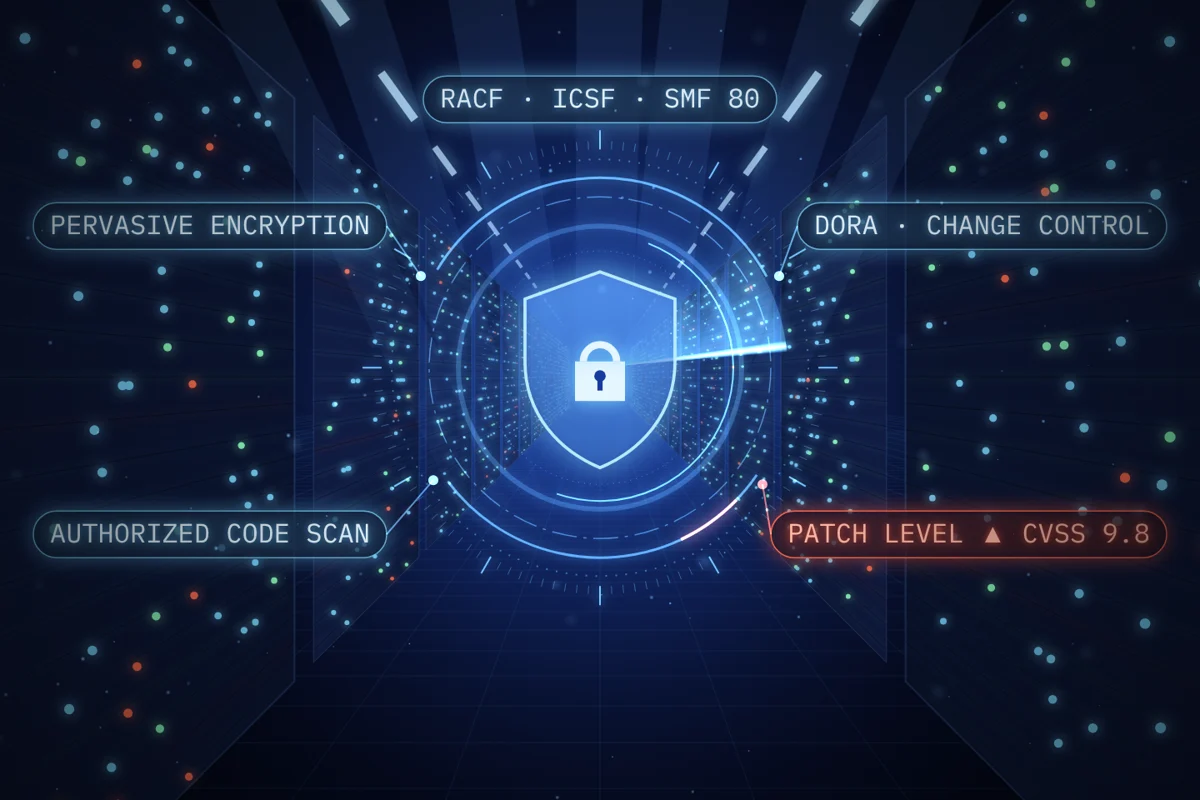
In this issue, we focus on mainframe security and compliance, from the code that runs on z/OS to the controls auditors expect to see. As AI speeds up both software development and cyberattacks, the assumption that the mainframe is secure by default no longer holds. The articles cover compliance, change control, encryption, application security and the integrity of authorized code.
On the compliance side, IBM zSecure Compliance brings audit and compliance work together in one solution, while the z/OS Change Tracker article explains why DORA makes documented change control an obligation for financial institutions. The Pervasive Encryption article shows what “encrypt everything” means in practice for Db2 system programmers.
Security doesn’t stop at RACF, ACF2 or Top Secret. The CICS article shows how weaknesses inside applications can expose data, and the zACS and zACM article explains how flaws in authorized code are found on test and live systems. The code-vetting article looks at a related question: how to keep standards and security in place when retiring experts, contractors and AI assistants all change mainframe code. Finally, AI Makes Mainframe Security More Vulnerable makes the case for treating patching as a continuous, risk-driven practice.
Thanks for reading MainframeMatters!
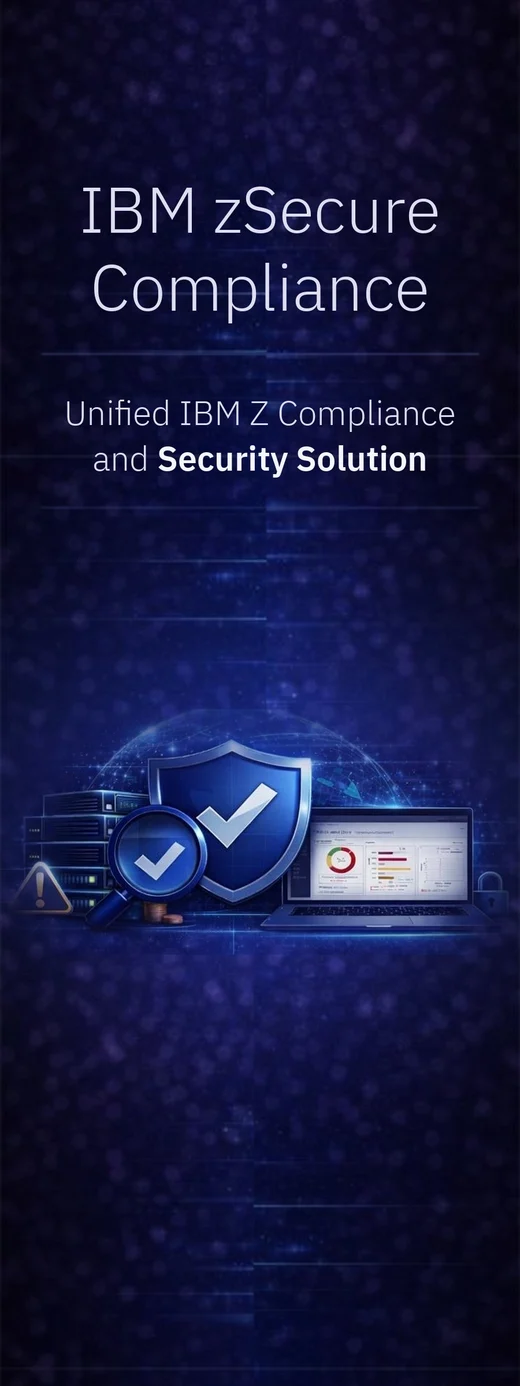
IBM zSecure Compliance: Transforming Mainframe Compliance from Burden to Competitive Advantage
IBM zSecure Compliance bringing together the battle-tested capabilities of zSecure Audit and IBM Z Security and Compliance Center together with groundbreaking AI-powered sensitive data discovery and classification, all unified into a single, intelligent compliance solution built specifically for the mainframe.
For compliance teams managing IBM Z environments, this isn’t just another product —it’s a game-changer. It addresses the challenges you’ve been navigating for years: fragmented tools, lengthy audit preparation cycles, manual evidence gathering, and the constant risk of compliance drift between audits
The Real Cost of Traditional Compliance Approaches
Let me share what we're hearing from our customers across banking, insurance, healthcare, and government sectors:
Need for a Streamlined Compliance solution - A major European bank recently told us their quarterly PCI DSS audit preparation consumed 160+ person-hours across security, compliance, and mainframe teams. Their process involved manually collecting evidence from multiple tools, coordinating with six different teams, and scrambling to document security controls that auditors couldn't easily validate...(Read more)

Vetting Mainframe Code
When Anyone, or Anything, Can Write It
For organizations running critical COBOL, Assembler, PL/I or Natural applications, the question of who writes the code has changed. Senior developers are retiring, contractors and outsourcing partners carry more of the load, and AI coding assistants now generate and modify mainframe code at a pace no team could match a few years ago.
What has not changed is the requirement that code promoted to production meet organizational standards, not introduce security risk, and be maintainable by whoever or whatever inherits it next. In regulated industries, the organization must also be able to prove the above.
Code vetting processes are changing with the times. The most effective approach today combines a predictable, deterministic application of code checks based on a library of rules that pass the same verdict every time, with AI, which brings cost-effective judgment, explanation, and remediation to edge cases.
More Change, From More Authors
Traditional code review assumed a small, stable group of developers who knew the house standards. Peer review and a handful of senior reviewers could keep up. Outsourcing and AI-coding have changed the rules. Contractors bring their own habits with each new author another source of variation. AI assistants produce change at a dramatically accelerated pace. They also make different mistakes than do people. They may add needless complexity, or produce different output for the same prompt on different days.
Manual review cannot scale to keep pace. An automated gate is the only form of review and remediation that can accommodate the increased variability and rate of change... (Read the full article)
Pervasive Encryption on z/OS: What Every Db2 System Programmer Should Know
Pervasive Encryption on z/OS: What Every Db2 System Programmer Should Know
PervasiveEncryption_square_1218
When I first started exploring IBM’s idea of “encrypt everything, everywhere, all the time,” I assumed it would be a simple infrastructure feature that lived far away from my day-to-day responsibilities as a Db2 systems programmer. What I discovered was quite the opposite. Pervasive Encryption is transparent to applications, but it introduces a new set of decisions and tuning levers for those of us who run and manage Db2 on z/OS.
Pervasive Encryption is an IBM z/OS security capability introduced with z14 and later systems. The goal... (Continue reading)
IBM z/OS Change Tracker: Why Mainframe Change Tracking Matters Under DORA
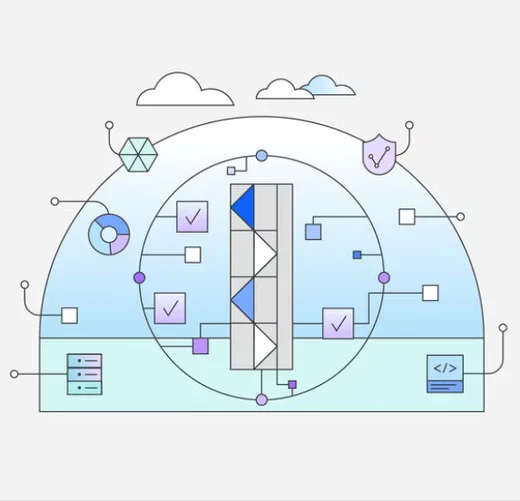
The Digital Operational Resilience Act is not vague about change control. It does not treat system changes as an informal operational preference. It makes controlled change management part of the resilience obligation for financial entities.
The clearest language sits in Article 9(4)(e) of DORA. It requires financial entities to: “implement documented policies, procedures and controls for ICT (Information and Communication Technology) change management, including changes to software, hardware, firmware components, systems or security parameters... (See article)
CICS Vulnerabilities Uncovered — And How to Secure Your CICS Applications

When the mainframe is well-configured, it can be one of the most secure platforms in the world. Through proper set-up and the adoption of security measures, the cyberattack risks can be minimized.
Philip Young, director of mainframe penetration testing at NetSPI, says that during a majority of security assessments, “there’s always some nook that’s not configured properly.” To ensure the security of the mainframe, its applications, and the data, he says organizations need a multi-pronged approach because mainframes are often running the firm’s most critical infrastructure.
At many enterprises, there are a number of different staff teams that engage with the mainframe and its data, which makes security essential. “You must look at the security not only of the mainframe, but also application security and the security within the application. Each layer has different accountability levels,” says Young. “For instance, cybersecurity has its own accountability layer, as does the architecture, the application, and on down the chain.” (Continue to the article)
Why use zACS? Why use zACM? A brief technical review of both.
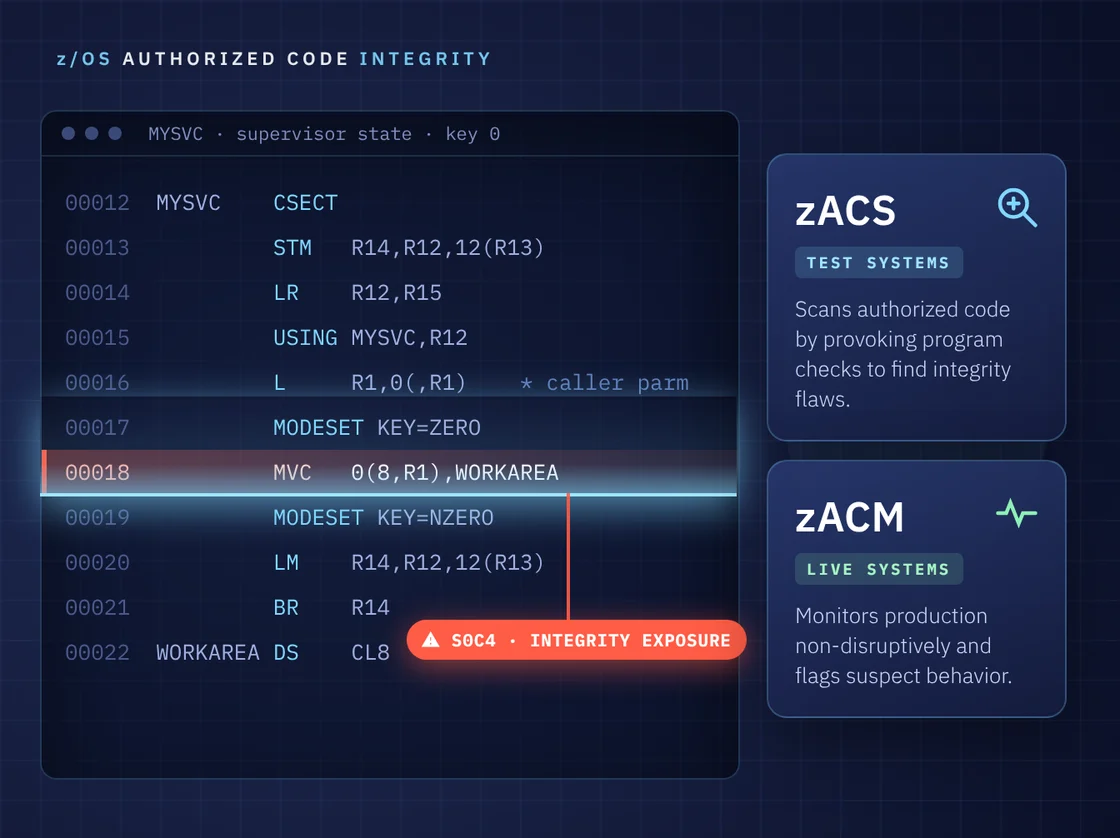
How does the z/OS Authorized Code Scanner (zACS) find so many severe security vulnerabilities?
When I was creating the internal tools that later formed the basis for zACS, the problem I was trying to solve was clear. How can you test something without an API guide? What if you didn't even have the source code? Would you need to disassembled the code and figure it out, or was there another way? IBM knew how to tell if a program check was a sign of a security vulnerability.
If an authorized service accesses storage it should not in a key it should not, or branches to a location it should not, as a result of a call from an unauthorized caller, it is a strong indication the failing instruction is violating system integrity and needs to be corrected... (Read full article)
AI Makes Mainframe Security More Vulnerable. What Now?
Frontier AI is both exciting and scary. Because it amplifies the power and productivity of digital creators and cyber criminals.
Although mainframes traditionally enjoyed enhanced security through obscurity, innate complexity, and superior reliability, that is no longer a given in the age of AI. In fact, recently released frontier AI models possess deep knowledge of mainframe architecture, allowing attackers to rapidly identify weaknesses and exploit vulnerabilities.
And they’re doing it faster since AI serves as a powerful force multiplier for offensive hackers. This creates an uneven dynamic in a world where defenders must be right 100% of the time, while attackers only need to succeed once.
Because of this, leading organizations must abandon the assumption that mainframes are inherently secure. They must actively and regularly audit their configurations, software, and architecture using best practices, such as penetration tests, and continuously update their security controls with increasing agility. Think monthly, weekly, if not daily, security patches (depending on your security profile, your organization's risk profile, and operational requirements) like every other front-facing piece of software does today..,
All images are property of their respective owners or sourced via Magnific.
If you found this valuable, please consider sharing it with your colleagues.