


Welcome to MainframeMatters Sept/Oct issue!
In this issue, we focus on how enterprises can get more from Db2 for z/OS while preparing their environments for new demands. The articles cover recent Db2 13 capabilities, AI working directly with mainframe data, SQL quality, workload performance, authentication and the protection of sensitive data.
When it comes to performance, the SQL review and concurrency-versus-throughput articles show how better decisions around SQL and workload management can improve the operation of Db2. The QuickSelect article looks at another common source of overhead: SQL queries that repeatedly request the same result sets. QuickSelect serves these requests directly from memory, reducing repeated Db2 processing and helping shorten demanding Batch runs without requiring changes to applications, databases or JCL.
The Function Level 509 article looks at the continued modernization of Db2 itself, while IBM SQL Data Insights Pro brings AI analysis directly to data held on the mainframe. The Kerberos and data-masking articles complete the picture by addressing secure access to Db2 and the safe use of sensitive information across development, testing, analytics and AI.
Thanks for reading MainframeMatters!

Announcing Function Level 509 in Db2 13 for z/OS
With the availability of PTF UO07568 for APAR PH70028, you can now activate function level V13R1M509 to enable the following new capabilities in your Db2 13 for z/OS environment.
Converting Db2 catalog and directory objects to UTS
Function level 509 enables a process for converting table spaces for Db2 catalog and directory tables from deprecated non-UTS types to partition-by-growth universal table spaces (PBG UTS). This conversion improves performance, simplifies administration, and aligns catalog objects with modern Db2 storage architecture.
When you’re ready to convert your catalog objects, you can use the REORG TABLESPACE utility with the new CONVERTUTS option. The conversion process is designed to minimize disruption and can be performed incrementally, allowing you to convert objects at your own pace based on your operational requirements. (Read more)
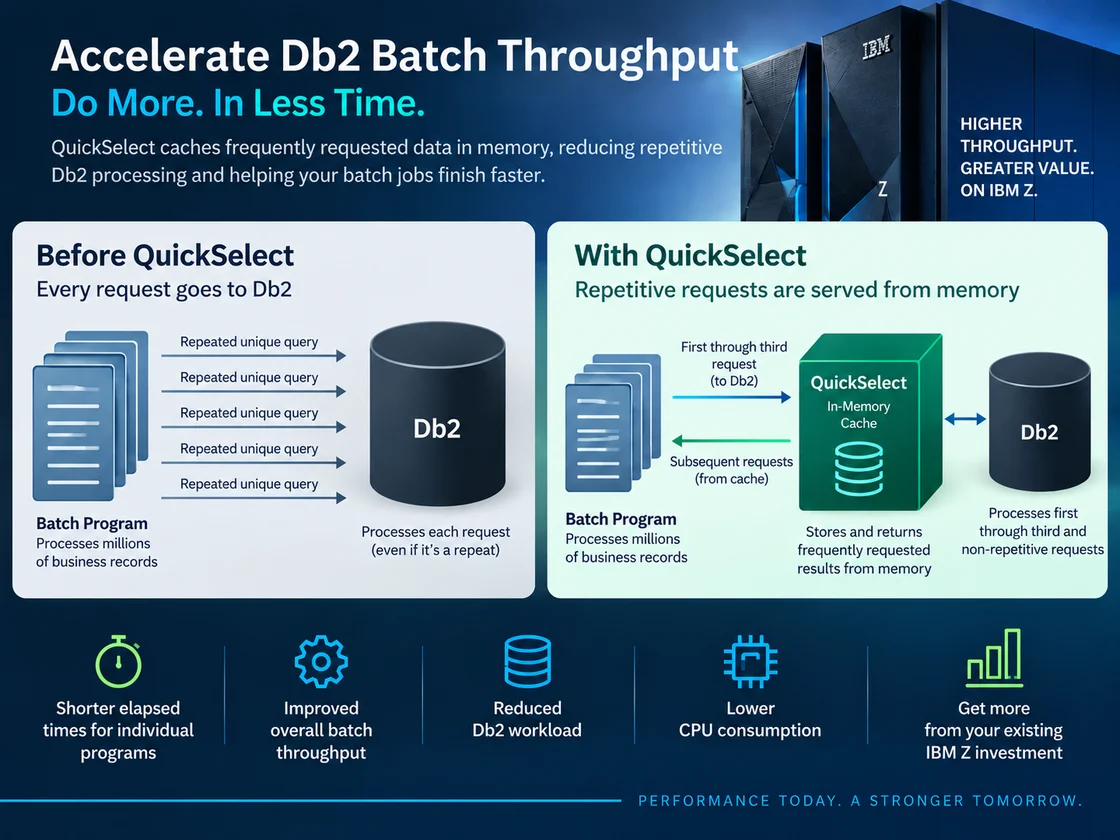
Accelerating Db2 Batch Throughput using QuickSelect
For many organizations running Db2 for z/OS, the batch window remains a critical operational constraint. Nightly and periodic jobs may need to process millions to billions of records before reports are generated, downstream systems receive their data, online processing begins, or the next business cycle starts.
Over the years, organizations have invested heavily in improving batch performance. SQL has been tuned, indexes optimized, buffer pools tuned and application logic refined. Yet an often-overlooked source of overhead remains: repetitive SQL that ask Db2 for the same results over and over again.
QuickSelect for Db2 addresses this specific problem by caching frequently requested SQL result sets in memory and satisfying subsequent identical requests from cache rather than Db2 having to regenerate the result. For most batch workloads, eliminating this repetitive Db2 processing translates directly into shorter elapsed times for individual programs and improved overall throughput.... (Read the full article)
A SQL review workflow

It is important to review SQL statements during testing... certainly before they get to production! A good SQL review workflow shouldn’t feel like bureaucracy, instead it should feel like a safety net that consistently catches performance problems before they hit production. The key is to structure the workflow so that it’s repeatable, lightweight enough to follow, and grounded in how databases actually execute queries.
Here’s a practical, end-to-end workflow you can implement. (Continue reading)
Bringing AI to mainframe data

We are excited to announce IBM® SQL Data Insights Pro a new AI-powered capability that uncovers hidden patterns in mission-critical data directly inside Db2® for z/OS®.
IBM Z has served as the trusted system of record for high value transactional processing for decades. Within this transactional data are behavioral patterns that can reveal fraud risk, customer intent, operational anomalies and more. Yet many organizations still copy mainframe data to external analytics platforms.. (See announcement)
Concurrency vs. Throughput in Db2

As Db2 DBAs we often find ourselves chasing two elusive targets: speed and capacity. We want our systems to handle everything all at once, and we want it done yesterday. But as database architectures evolve and workloads grow increasingly complex, DBAs must constantly manage the delicate, often misunderstood relationship between two fundamental metrics: Concurrency and Throughput.
It’s easy to mistake one for the other, or to assume that maximizing one automatically boosts the other. But the two are not the same. Let’s break down what these terms really mean for your Db2 for z/OS subsystems and why balancing them is the key to a healthy production environment.
In an ideal world, as concurrency increases, throughput rises right along with it. But database systems don't operate in a vacuum. They are bound by physical limitations: CPU, memory, I/O bandwidth, and, most importantly, locking and latching mechanisms.
If you increase the number of concurrent threads entering your Db2 subsystem, throughput will generally scale linearly, at least up to a point. But eventually you hit a tipping point that is referred to as the "knee of the curve." (Continue to the article)
Configuring Db2 with Kerberos Authentication

Kerberos authentication centralizes security by using ticket-based authentication to authenticate users and services without sending passwords over the network. When Db2 is integrated with Kerberos:
- Db2 server authenticates clients based on Kerberos service tickets.
- Clients authenticate to the Kerberos Key Distribution Center (KDC) to obtain tickets.
- Db2 validates client tickets via the keytab file containing its service principal credentials.
- Authentication becomes seamless and secure. (Read full configuration)
Db2 data masking

Db2 data masking protects PII in mainframe systems, enabling compliant dev, test, analytics, and AI.
What is Db2 data masking?
Db2 data masking replaces sensitive information stored in IBM Db2 databases with realistic but fictitious data that preserves the original data's format, structure, and referential integrity with masked data from other systems. This process allows organizations to use production-like datasets in non-production environments without exposing actual customer data, employee records, or proprietary business information.
IBM Db2, whether deployed on z/OS mainframes, Linux, Unix, Windows systems, or cloud platforms, contains vast amounts of enterprise data. Organizations need data masking capabilities to safely share this information across development teams, QA environments, business partners, and analytical data stores, while meeting compliance requirements under GDPR, HIPAA, PCI DSS, DORA European regulations, and other data masking standards. (Continue reading)