
For many organizations running Db2 for z/OS, the batch window remains a critical operational constraint. Nightly and periodic jobs may need to process millions to billions of records before reports are generated, downstream systems receive their data, online processing begins, or the next business cycle starts.
Over the years, organizations have invested heavily in improving batch performance. SQL has been tuned, indexes optimized, buffer pools tuned and application logic refined. Yet an often-overlooked source of overhead remains: repetitive SQL that ask Db2 for the same results over and over again.
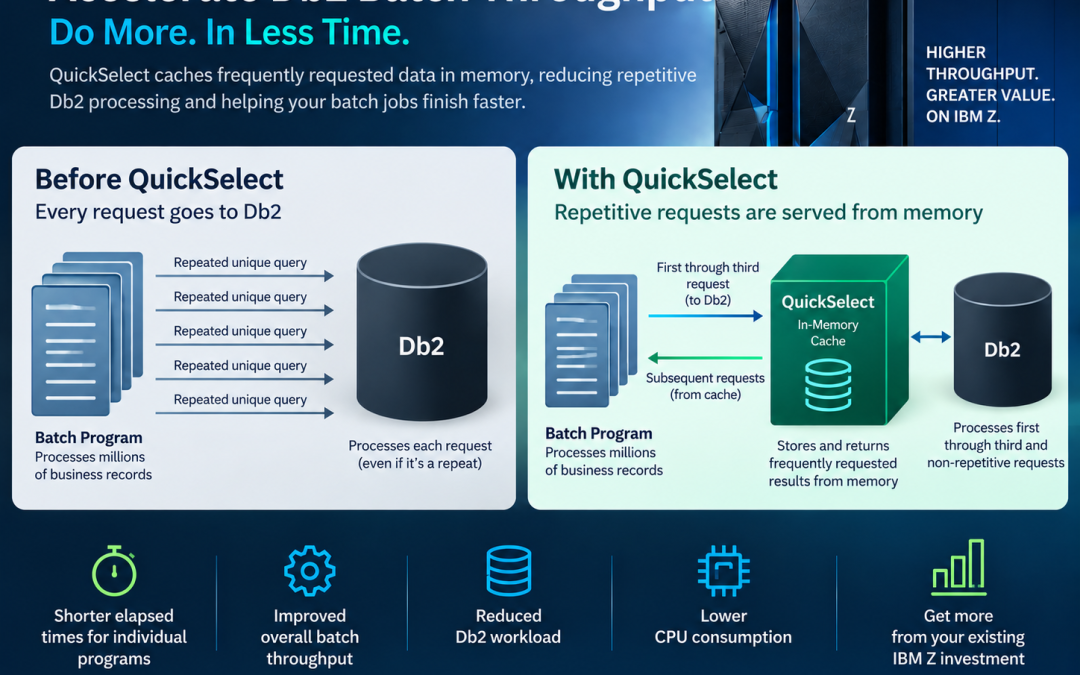
QuickSelect for Db2 addresses this specific problem by caching frequently requested SQL result sets in memory and satisfying subsequent identical requests from cache rather than Db2 having to regenerate the result. For most batch workloads, eliminating this repetitive Db2 processing translates directly into shorter elapsed times for individual programs and improved overall throughput.
The Aggregate Cost of Repetitive SQL
Consider a batch program processing tens of millions of business records. For each record, the program may issue SQL to retrieve reference information such as product code, customer classification, authorization value, pricing rule, geographic code, or other relatively static data. The SQL are tuned, have supporting indexes, and have been bound with respect to current statistics. The required pages reside in a Db2 buffer pool, eliminating I/O. But Db2 still has work to do. Each query needs Db2 to produce the requested result. When a simple lookup is performed once, that overhead is insignificant. When the same lookup pattern (i.e. SQL_1 + Host Variable ‘A’ @ 20 times; SQL_1 + Host Variable ‘B’ @ 10 times; etc.) occurs hundreds of thousands or millions of times during a batch run, the cumulative cost is substantial. When these repetitions happen across multiple different SQL, the cost multiplies.
This is where result-set caching differs fundamentally from conventional database tuning. Instead of helping Db2 execute the repetitive request more efficiently, QuickSelect eliminates the need for Db2 to execute them at all.
How QuickSelect Changes the Processing Path
QuickSelect operates between the application and Db2. A unique request is determined by the SQL and its associated host-variable values. When a qualifying query (i.e. READ) is first seen, Db2 performs its normal work and generates the result. Once QuickSelect’s frequency threshold for caching is met for that specific query, the result set is stored by QuickSelect in its
self-managed cache (64-bit memory above the bar). Now when the same request occurs again, QuickSelect returns the cached result directly to the program. Requests that are not cacheable, or whose results are not in cache, continue to Db2 normally.
The distinction between result set and table data is important. QuickSelect is not another database and does not copy entire Db2 tables into memory. It selectively caches result sets for repetitive requests where caching provides value.
More Transactions Through the Same Batch Window
The immediate batch benefits are straightforward: less time spent processing repetitive SQL means one or more of the following:
- more business processing can be completed over a given period
- the same amount of business processing can be completed in less time
- the same amount of business processing can be completed in the amount of time, but at a lower rate of resource consumption
Suppose a job performs ten million Db2 requests during a nightly run, and a meaningful percentage are repetitive lookups that qualify for caching. Diverting those requests away from Db2 reduces the average amount of work required to process all business records. The cumulative effect can be significant. A small reduction in processing time per record, multiplied across millions of records, can translate into a meaningful reduction in total elapsed time.
Relieving Db2 Bottlenecks
QuickSelect benefits can extend beyond the individual job. Db2 is a shared resource. CPU cycles, buffer pool resources and other subsystem resources consumed by one workload are unavailable to others. When QuickSelect satisfies repetitive requests, the freed up Db2 resource is available for other work. The benefit extends beyond making individual queries run faster; QuickSelect removes unnecessary work from the broader Db2 workload. This is important when multiple Db2 batch jobs execute concurrently.
Performance Beyond the Buffer Pool
It is tempting to assume that there is little opportunity for improvement when frequently accessed Db2 data is already resident in a buffer pool. But a buffer pool caches pages, not SQL result sets. Db2 must still process the SQL and locate and retrieve the requested data from those pages. A result-set cache removes a delivery step by retaining and re-serving the answer previously produced by Db2.
Consequently, repetitive lookup-oriented SQL can benefit from QuickSelect even in a well-tuned environment with high buffer-pool hit ratios. Benchmarks demonstrate substantial improvements in result set delivery performance when compared with Db2 generating the same result sets from data pinned to Db2 buffer pools.
Maintaining Data Integrity
Performance is useful only if the results remain correct. Reference and lookup tables may change infrequently, but they do change. QuickSelect therefore monitors changes to underlying Db2 data. Updates made through SQL and changes made by Db2 utilities will cause QuickSelect to immediately invalidate dependent cached results. Subsequent requests are then directed back to Db2, allowing current results to be returned and eligible results to be repopulated in cache. This update sensitivity makes it practical to cache relatively static data without requiring the application itself to manage cache synchronization.
Improving Batch Performance Without Reengineering Applications
Perhaps the most significant operational advantage lies in how QuickSelect is introduced into an environment. Traditional application-level caching can require programs to be analyzed, modified, tested and redeployed. QuickSelect instead operates transparently and requires no changes to application code, JCL, or Db2 database structures. It can be activated or deactivated at will with no impact other than performance gains and CPU savings.
This makes QuickSelect particularly relevant to mature Db2 environments where applications are already highly optimized and where modifying decades-old production code to obtain another increment of performance is out of the question.
Getting More from Existing Db2 Batch Workloads
The central idea behind QuickSelect is simple: the fastest repetitive Db2 request is one Db2 does not have to execute again.
Batch programs frequently perform enormous numbers of individually inexpensive database lookups. Their cost becomes important because of repetition. QuickSelect attacks that repetition directly by allowing qualifying results to be generated once and reused from high-speed memory.
For organizations facing shrinking batch windows, increasing transaction volumes, CPU constraints, or simply the need to extract more performance from their existing IBM Z infrastructure, QuickSelect delivers a fresh, practical optimization opportunity. QuickSelect can reduce Db2 work transparently – allowing existing batch programs to process more data, in less time, with fewer Db2 resources.
Recent Comments